.svg)
.avif)
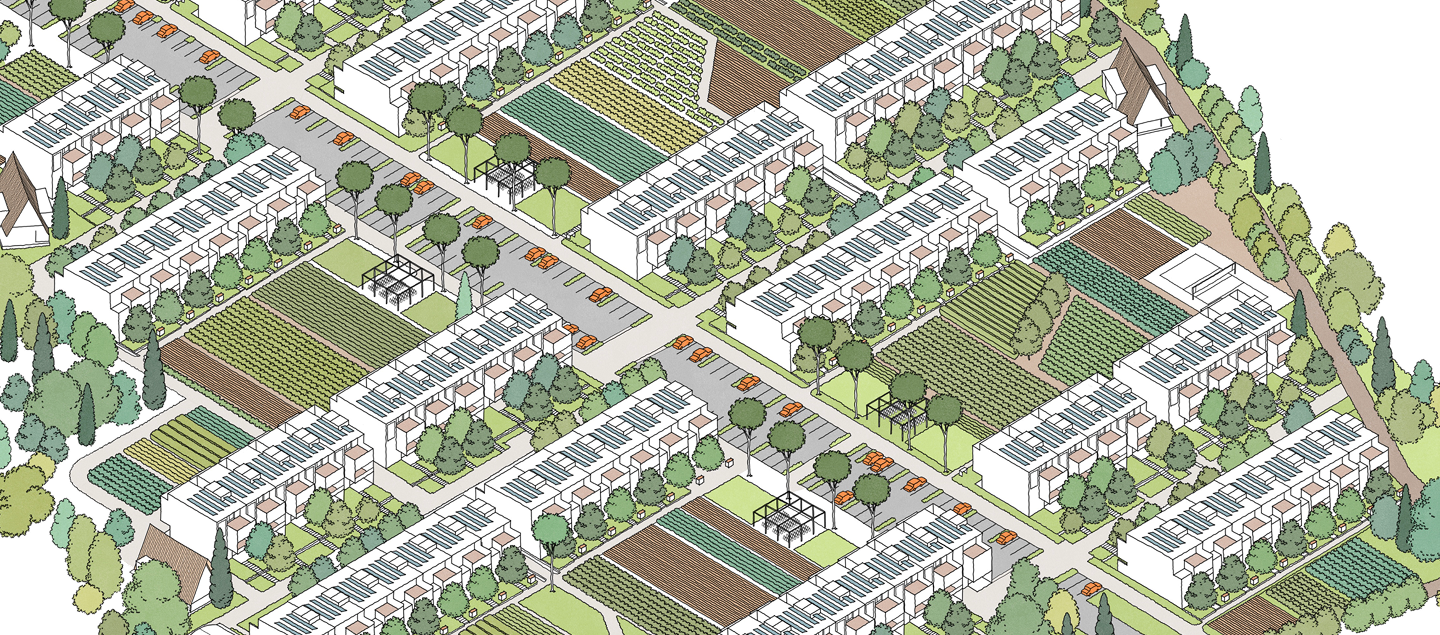
Net Zero Water Community at Organo Kandawada
Net Zero Water (NZW) Community
Organo Kandawada is designed to be a Net Zero Water (NZW) community. An NZW community relies minimally on external water sources and depends heavily on rainwater and treated wastewater to meet the overall water demands.
An ideal net zero water building uses on-site alternative water sources for all its requirements. There are three primary sources of water consumption in Organo Kandawada – domestic consumption for homes and common amenities, farming, landscaping, and animal husbandry.
The domestic water requirements are catered through rainwater stored in the dug well and municipal water. The rainwater collected is further treated through a water treatment plant and most part of the community’s water demand is for farming and landscaping, which varies from season to season.
Dug Well : A Reservoir for Water Resilience
Water resilience is a big goal we are trying to reach. To accomplish this, we are looking at various ways in which surface rainwater runoff can be tapped. Although groundwater sources can be reached if we go deep enough, we do not want to do that. At 1000 feet below the ground, we reach confined aquifers. These acquirers are blocked by rock layers above and below. Any water that is taken out of these aquifers is not easily replenished. It takes decades for the water to reach these deep reservoirs.
One way to recharge these deep aquifers is to put water back in the same borewells or similar borewells from which we are pulling water out. Although this creates a somewhat sustainable solution, there is no guarantee that the water we put in will come back to us as these aquifers underground spread across hundreds of acres of area.
There may come a time when the surrounding farmers continuously pull water out and we don’t reap any benefits from our efforts. To become drought resilient, the best option is to capture as much rainfall as possible within the boundaries of our community. This is where our dug wells come into the picture - they act as a buffer, a battery bank for water.
During times of extreme drought, the community shall manage water better using this reserve which is nonexistent in other communities. Depending on the severity, strategies are being formulated on how to use this water.
Zero Discharge Community
The waste water generated from homes and common spaces is diverted into a Sewage Treatment Plant (STP) and treated to a tertiary level.In Rurban communities, the treated waste water is directly used for landscaping due to high demand, instead of diverting it to flushing water in homes. The treated waste water is rich in nutrients and improves soil fertility. Also, the sludge generated as a by-product of this process is sun dried and mixed with soil.



.jpeg)