.svg)
.avif)
The Architecture of Belonging
The Architecture of Belonging
How Amenities Shape Our Daily Rituals
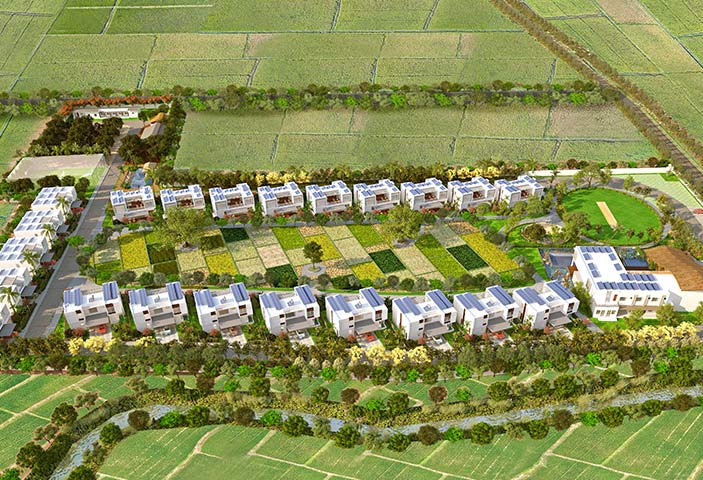
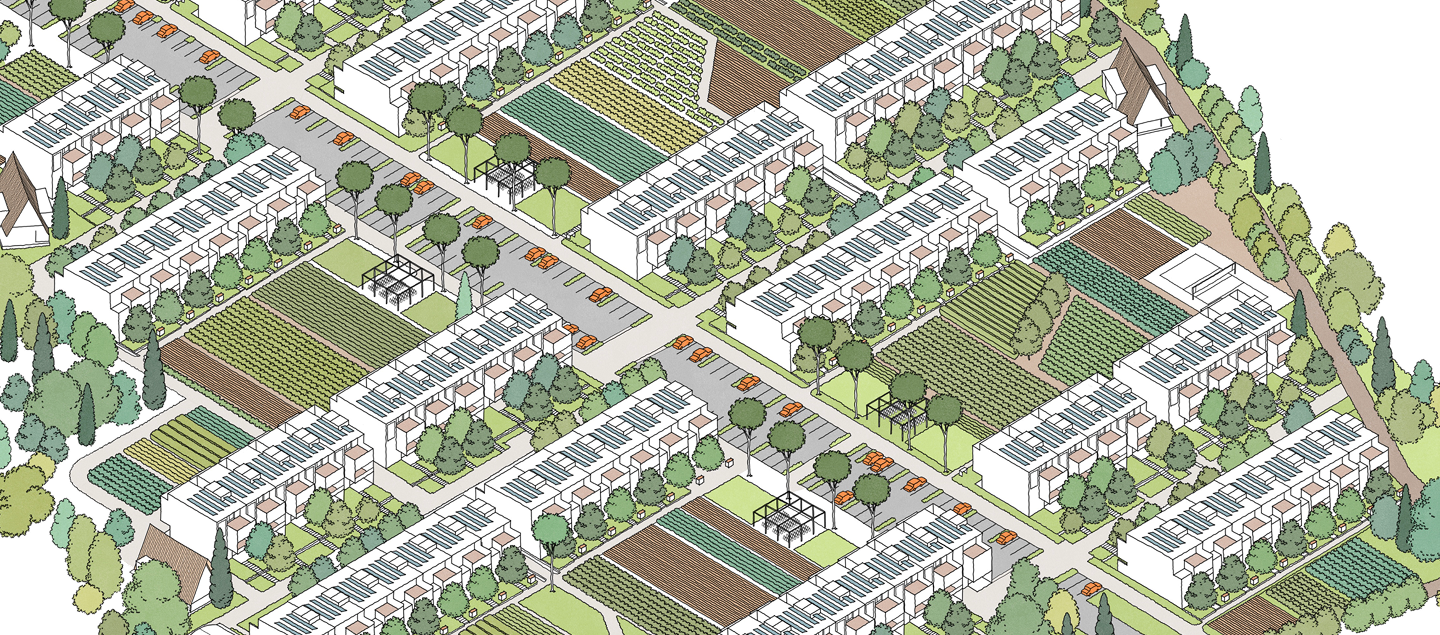
At Ibrahimpalle, common spaces do more than just fill in the gaps between homes. They allow life to unfold in ways that aren’t always visible on a layout. From the spaces between homes to the shared courtyards, veedhis, and verandas, every design element contributes to a sense of belonging. This article walks through how these amenities were designed, not as add-ons, but as everyday enablers of a slower, more connected life.
1. Forest Trails: The Wisdom of Walking
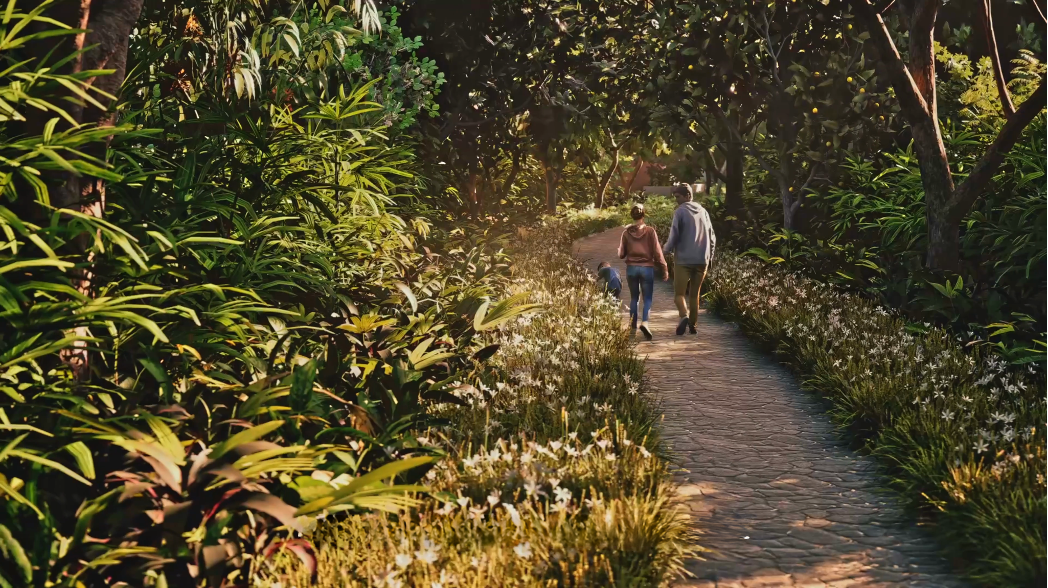
Not all journeys need destinations. The forest trails at Ibrahimpalle are designed for wandering, wondering, and witnessing, offering a slow immersion into the land’s quiet language.
Laid lightly on the contours, the trails meander through native fruit orchards, shade groves, and under-canopy wild zones. The surfaces vary, laterite gravel, natural stone, matted leaf mulch. Each inviting a different rhythm of walk. Benches are carved from fallen trunks. Light is dappled. Wayfinding is subtle, not obtrusive.
As architects, our goal was not to carve paths but to let them be discovered as you meander. Trails that respect tree roots, that listen to the wind’s direction, that allow for silence. The landscape is designed not just for people, but for birds, butterflies, bees, and the occasional fox or hare. It’s a shared habitat.
The well-being gift here is multi-dimensional: cardiovascular health, sensory healing, nature education, and emotional grounding. Parents walk with children. Friends jog at dawn. Elders sit and listen to the forest breathe.
The forest trails are our most profound amenity, not flashy, but essential. Because walking amidst trees is not a luxury. It is a return to who we are.
2. Guest Suites: Hospitality That Feels Like Home
When guests arrive at Ibrahimpalle, the guest suites are our way of saying: stay, slow down, and let this land hold you, too.
Architecturally, the suites are designed to offer privacy, yet remain within walking distance of communal areas, so guests feel welcome without being isolated. The layout mimics that of a well-appointed home: a cozy bed chamber, a sunlit bath, a small writing nook, and a terrace/balcony to sip morning coffee with a view of the gulmohar.
The material palette is calming with earth-toned flooring, handwoven throws, natural wood elements, and a touch of local art. It feels personal, not sterile. Like a home, not just a temporary room.
For residents, these suites offer flexibility. Invite cousins over during festival season. Host friends for a weekend. Let friends experience the lifestyle before they consider moving in. And for the guests? It’s often a first taste of how sustainability and beauty can coexist.
More than a room, the guest suite is a gentle welcome. It says: you are part of this circle, even if only for a while.
3. The Cow Hostel : Gentle Companions in a Rural Rhythm
In the heart of Ibrahimpalle, the Cow Hostel is not just a utility structure, but a way for us to connect to our ecosystem beyond fruits and flowers.
Designed with care for both animal welfare and human interaction, it follows passive ventilation principles, with cool, shaded stalls, floors for hoof comfort, and generous walking space for the cows. Dung and urine are channeled into compost and biogas systems, closing loops between living and giving.
But beyond its technical efficiency, this space offers soul care. Children visit to feed, elders to observe, volunteers to clean. There’s a slowing down here, a return to a softer pace.
For many families, cows are symbolic of abundance, patience, and care. Interacting with them cultivates gentleness, respect, and groundedness, virtues so often lost in urban life.
As architects, we integrated the cowhostel with the trail network and cultural centre, so it’s never out of reach, never ornamental. It belongs.
Because a community that honors its animals learns to honor itself.
4. Prefunction & Banquet Hall: A Room for the Many Moments
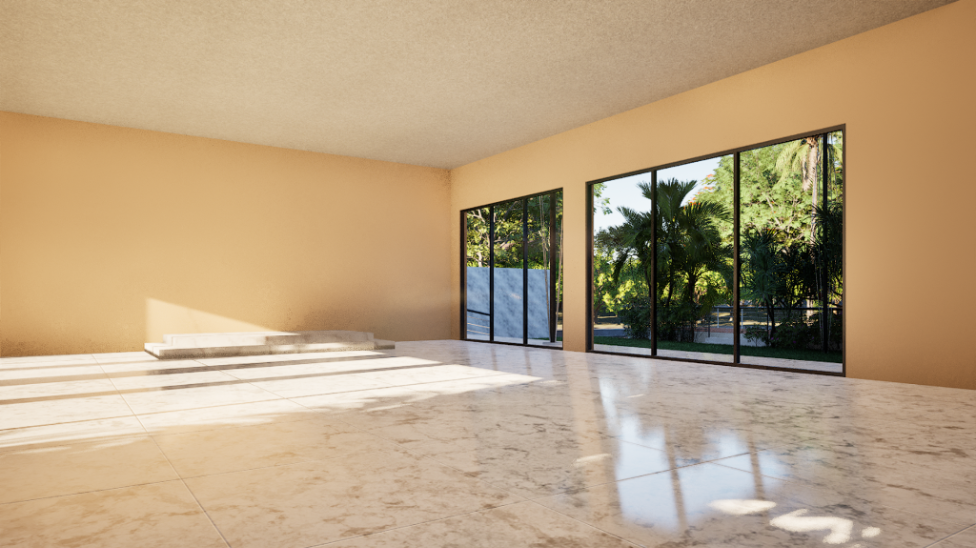
Some moments need a space of their own. The banquet and pre-function hall at Ibrahimpalle offers just that, a place where families gather, friends reconnect, and occasions are marked with quiet joy or large celebration.
The hall is designed with both purpose and grace. The pre-function area opens into a lawn, making it easier for people to move between indoors and outdoors. The banquet hall itself is well-lit and built to feel warm rather than formal.
Materials are chosen to feel neutral and lasting; elegant finishes, simple floors, and muted textures that suit different kinds of events. Whether it’s a wedding, a farewell, a naming ceremony or a community meet, the hall adapts without fuss.
From a planning point of view, the entrance is direct, the flow of guests and service teams is smooth, and the location avoids disturbing the quieter zones of the community.
This is not just a rental space. It’s where the life of the community gathers—celebrating what has passed, what is changing, and what’s just beginning.
This hall doesn’t just hold events. It holds a community’s shared calendar of joy.
5. Community Kitchen: A Hearth for Many Homes
In every Indian village, the firewood hearth is where stories begin. The community kitchen at Ibrahimpalle is a contemporary homage to that spirit, not just for cooking, but for enabling easy connection as a community.
Set close to the plaza and event zones, the kitchen serve large groups during festivals, workshops, or health programs. Ventilation is paramount, with cross breezes, smoke outlets, and natural light shaping a clean and safe culinary environment. The workspace supports bulk cooking, with designated areas for prep, wash, dry, and store, all without chaos.
But the magic is not in the equipment. It’s in the intention of the design. To be a place where a few neighbors can come together to pickle mangoes, teach millet recipes, or prepare prasadam after a puja.
For families, it’s a fallback kitchen when they want a break from meal planning, prepping, cooking and cleaning. For visitors, it’s a peek into how a sustainable community nourishes itself, seasonally and socially.
Architecturally, it’s humble, but profoundly social. The community kitchen is the heart behind the scenes, where nourishment is a shared act of care.
6. Alfresco Dining: A Table Beneath the Sky
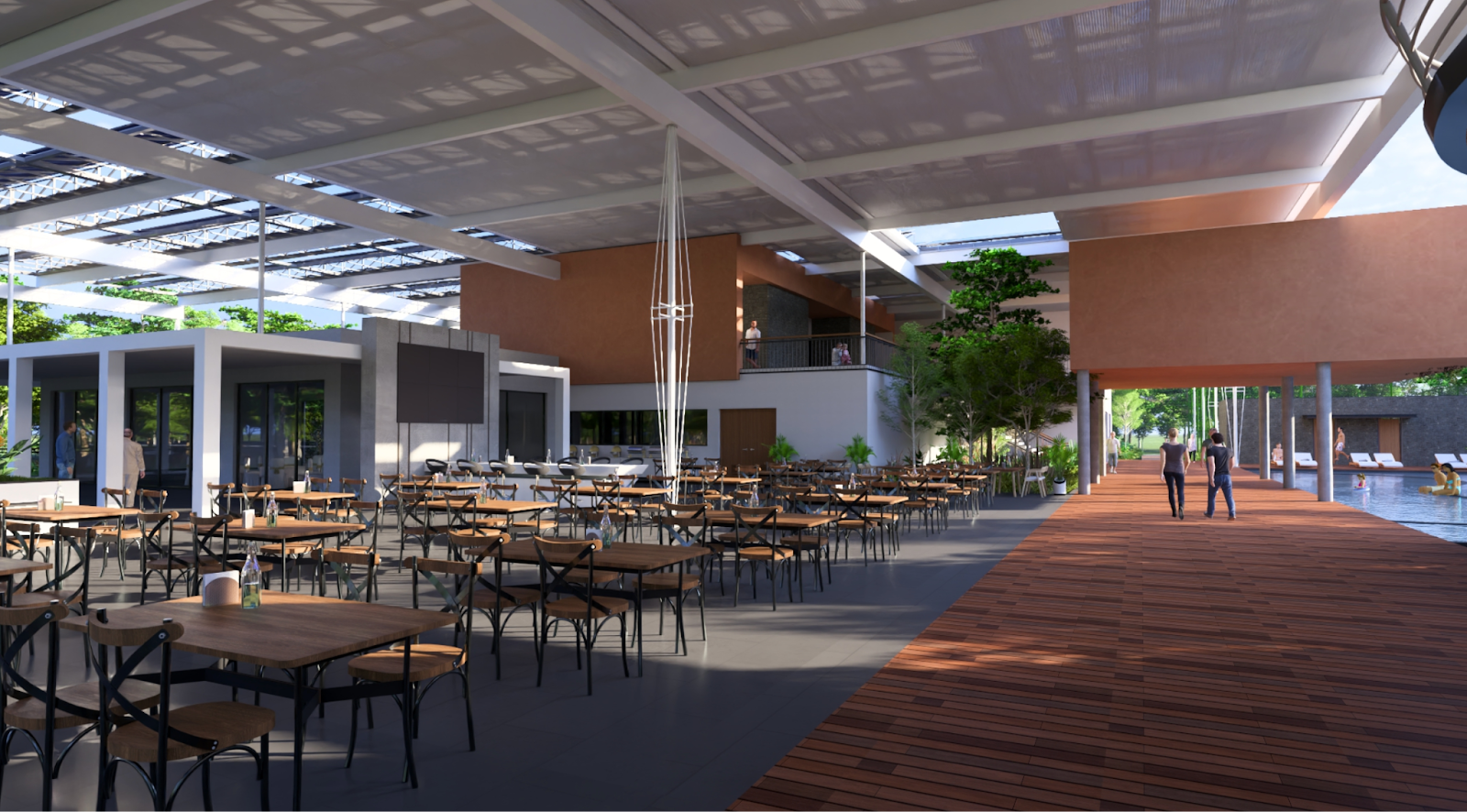
There is something primal and joyful about eating under the open sky where you can feel the breeze and the sunshine. The alfresco dining area at Ibrahimpalle is not just a patio with tables. Designed to be an intentional pause where food, nature, and companionship meet.
Architecturally, this space is calibrated for comfort and sensory joy. Shaded by fruiting trees, cooled by stone flooring, and animated by filtered sunlight, it invites residents to eat slowly, laugh loudly, and remember the scent in the air as a condiment.
Its positioning adjacent to the community kitchen is intentional, enabling a short, seamless journey from stove to table. The furniture is chosen not for uniformity but for warmth with benches with backs, stools for kids and counters for casual bites.
This space can be many things: a breakfast spot for the early risers, a tea adda for the elders, a storytelling circle for kids over snacks, a cheering throng for a cricket match. On weekends, it hosts potlucks, where dishes are shared as generously as stories.
The health benefit lies not in the calories counted but in the community it cultivates. When people dine together outdoors, they form deeper bonds, better digestion, and lasting memories.
This is not just dining. It’s a return to food as ritual, and open air as nourishment.
7. Barbecue Area: Flame, Food, and Fellowship
The barbecue area is a humble idea elevated by togetherness. At Ibrahimpalle, it’s not about gourmet grilling, it’s about the social theatre of fire and food under open skies.
Positioned amidst fruiting trees and near the alfresco zone, the barbecue pit is a stone-and-metal ensemble with counters, seating, wind buffers, and smoke ventilation, all choreographed for safe and comfortable gatherings. Lighting is warm, inviting, and positioned for twilight feasts.
We designed it to feel both rustic and refined. Fire is contained, but the spirit is free. A space where grandparents roast sweet potatoes, teens flip skewers, and neighbors exchange recipes over smouldering coals.
From a wellness lens, this is emotional nourishment. Families take time to prepare food together. Conversations stretch longer. There’s laughter, occasional singing, and the rare joy of slowing down enough to enjoy the crackle of firewood.
Architecturally, this is a space not for function, but for memory. Every grill night becomes a story. And every story, a reason to belong.
Multi-Use Plaza: A Shared Open Space
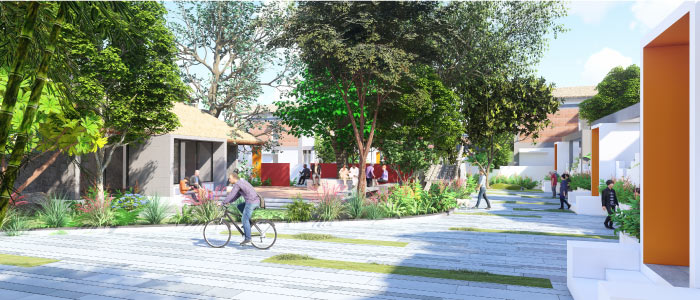
The multi-use plaza is a simple, open space designed for pause and possibility. It’s not a formal ground or a fixed-use area. It’s where small events take shape spontaneously and neighbours cross paths without needing to plan for it.
The design moves between paved and green, shaded and open. Edges are soft, pathways connect to clusters, and sightlines stay clear. It’s meant to feel accessible from all directions. The surface can hold a morning market, a community gathering, or just scattered conversations.
There’s no dominant use here. One morning, it might host a rangoli competition. Another evening, it’s just a few chairs pulled up for a book reading. A child’s cycle might be parked next to someone feeding birds.
The plaza feels part of daily life. It’s not fenced or formal, and it doesn’t require invitation. Over time, it becomes the place that simply holds space for gathering, for slowing down, for being together.
9. Tot Lot: A Garden Where Childhood Grows
The tot lot at Ibrahimpalle is not a plastic playground. It is a tactile wonderland, where barefoot mornings, muddy knees, and shared giggles become everyday rites of passage.
We designed it as a safe microcosm of the larger landscape scaled to children, rich in textures, layered in discovery. Instead of synthetic equipment, there are sand pits, wooden climbing frames, balance logs, chalk walls, and interactive water play channels. The ground is soft with grass and natural mulch. Shade comes from trees, not tensile fabric.
As architects, we were careful about line of sight, parents can supervise without hovering, benches are placed for rest and watchfulness, and access is barrier-free for strollers and small bicycles.
The well-being benefit here is foundational: gross motor development, sensory learning, and early socialisation. Children learn negotiation, patience, and courage, not from rules, but from play itself.
In a world of screens, this is our rebellion: a space where childhood is allowed to unfold with dirt under the nails and laughter in the air.
10. Cultural node: For the Collective Soul
At Ibrahimpalle, the clubhouse acts as a cultural node and is a space where language is heard, traditions are danced, and silences are understood.
Designed as a light-filled and context-sensitive area, it is rooted in proportion and presence. Its walls do not demand attention. The architecture draws from local inspiration but reinterpreted for multipurpose use.
The space is modular, able to host a Carnatic concert, a storytelling evening, a local crafts bazaar, or a memorial ceremony. It accommodates both performance and pause.
From a health and wellbeing lens, this is where intergenerational memory is preserved. Children watch their elders perform. Parents pass on rituals. Neighbors become co-creators in festivals and feasts. It is a counterbalance to digital disconnection, a place for embodied presence.
And as architects, we see this space as a container for the community’s emotional life. Neither grand nor austere, it is shaped for everyday beauty. Because a community that sings, weeps, and laughs together under one roof is a community that will last.
11. Mini Theatre: A Room Where Stories Gather
In every culture, stories gather us. The mini theatre at Ibrahimpalle is not just a dark room, this space creates emotional health. It provides catharsis, laughter, reflection. It brings together families, neighbors, and even strangers who may not speak in the veedhi, but share a laugh during a movie.
Acoustically refined, thermally insulated, and visually balanced, this intimate screening room is designed for more than movies. It becomes a classroom during workshops, a debate hall for teens, a poetry night stage for residents, and yes, a place to watch a classic with popcorn and neighbors.
The seats are tiered for sightlines, but arranged for closeness. Lighting is layered, functional, but warm. The entrance ensures that outside noise doesn’t interrupt inner journeys.
A theatre, in this design, is not just for escape. It is for returning to each other, through story and shared emotions.
12. Spa : The Architecture of Letting Go
Wellbeing is often seen as something to schedule and indulge out of the ordinary, but at Ibrahimpalle, the spa and salon spaces are designed not for indulgence, but for recalibration on demand.
Here, architecture becomes therapy. The space is dimmed just enough to soften the eyes, textured with wood and stone to invite touch, and organized to create a sense of being held without confinement. There are no sharp acoustics, only the muffled comfort of privacy.
This space is not gendered or age-restricted. It welcomes grandparents for an oil massage, teens for a head massage before a big event, and parents who need twenty minutes of silence as they take a load off their feet with a footsoak.
From a design standpoint, circulation is key. The staff welcome guests into a tranquil lobby, guests flow from the warm waiting lounge into quiet treatment rooms. Every zone is planned with respect for hygiene, dignity, and sensory softness.
The spa restore more than appearance. They restore nervous systems. In a world of screens, high ambient noise and schedules, this becomes a rare space where the community slows down, not to consume, but to rest.
It is not just about self-care. It’s about remembering the self.

13. Gym: The Architecture of Strength and Energy
The gym here at Ibrahimpalle is not just equipment arranged in a room; rather, a space to cultivate discipline and presence.
From the architect’s lens, it is designed with clarity of circulation, natural ventilation, and visual motivation. Full-height windows overlook greenscapes, inviting light and movement into the space. Flooring choices absorb sound and impact, while materials like soft coloured paints and wood instill calm, so the body can be challenged, not stressed.
The layout supports a full range of motion: strength zones, cardio corners, flexibility stretches, and even quiet nooks for breathwork or stretching. Equipment is oriented thoughtfully, to promote engagement with views, not screens.
For residents, this space supports every season of life. Seniors can come early for balance routines. Parents carve out a quiet hour. Young adults can train with intensity, feeling empowered in a space that respects their solitude.
But more than anything, the gym is a mirror room not for vanity, but for commitment. A daily ritual where one slowly grows into their strongest self, step by steady step.
14. Indoor Badminton Court: Precision in Play
The indoor badminton court at Ibrahimpalle is a space to experience energy and exhilaration.
Structurally, the court features high ceilings and non-glare lighting ensuring that focus remains undistracted and the shuttle’s arc is always visible. The flooring is chosen for grip and give, supporting players across age groups without straining the joints.
This is not just a sports hall. It’s an invitation to movement. Children learn agility, adults rediscover competition, and elders find joy in soft rallies and lively spectating. The court’s dimensions offer space for doubles and singles, and its adjacency to changing rooms, spectator seating, and hydration points ensures every detail of the experience is cared for.
From a well-being perspective, badminton is among the most accessible, non-intrusive ways to build cardiovascular health, coordination, and mental alertness. Played indoors, it becomes a year-round habit.
As architects, we designed this not as a separate building but as a continuation of the community’s heartbeat. You hear laughter, hear the swoosh of a swing, and you know that inside, health is unfolding one rally at a time.
15. Multi-Play Court: A Canvas for Collective Energy
In every community, there must be space for the uncontainable energy of freeform play. The multi-play court at Ibrahimpalle is our response to that need; a recreational arena for movement, expression, and joy.
Designed with flexible lines and durable, low-heat materials, the court accommodates basketball, tennis, pickle-ball, and other games. Surrounded by soft-scaping and safe run-offs, it ensures boundaries are both clear and forgiving.
From an architectural perspective, the court is nestled within earshot but not in disruption. Close enough for parents to supervise, yet independent enough for young players to feel free. Shade structures and seating zones offer comfort to onlookers, while subtle lighting extends usability into twilight hours.
The thump of the ball, the squeak of shoes, the eruption of cheers, these are the sounds of a healthy neighborhood. For children, it is a stage of self-discovery. For teenagers, a space of connection and healthy competition. For adults, a place to reconnect with movement, competition, or casual camaraderie.
When we design for play, we design for resilience, belonging, and vitality. The multi-play court holds all three with lines that invite, not divide.

16. Natural Swimming Pond with Pool Deck: Returning to Water, Gently
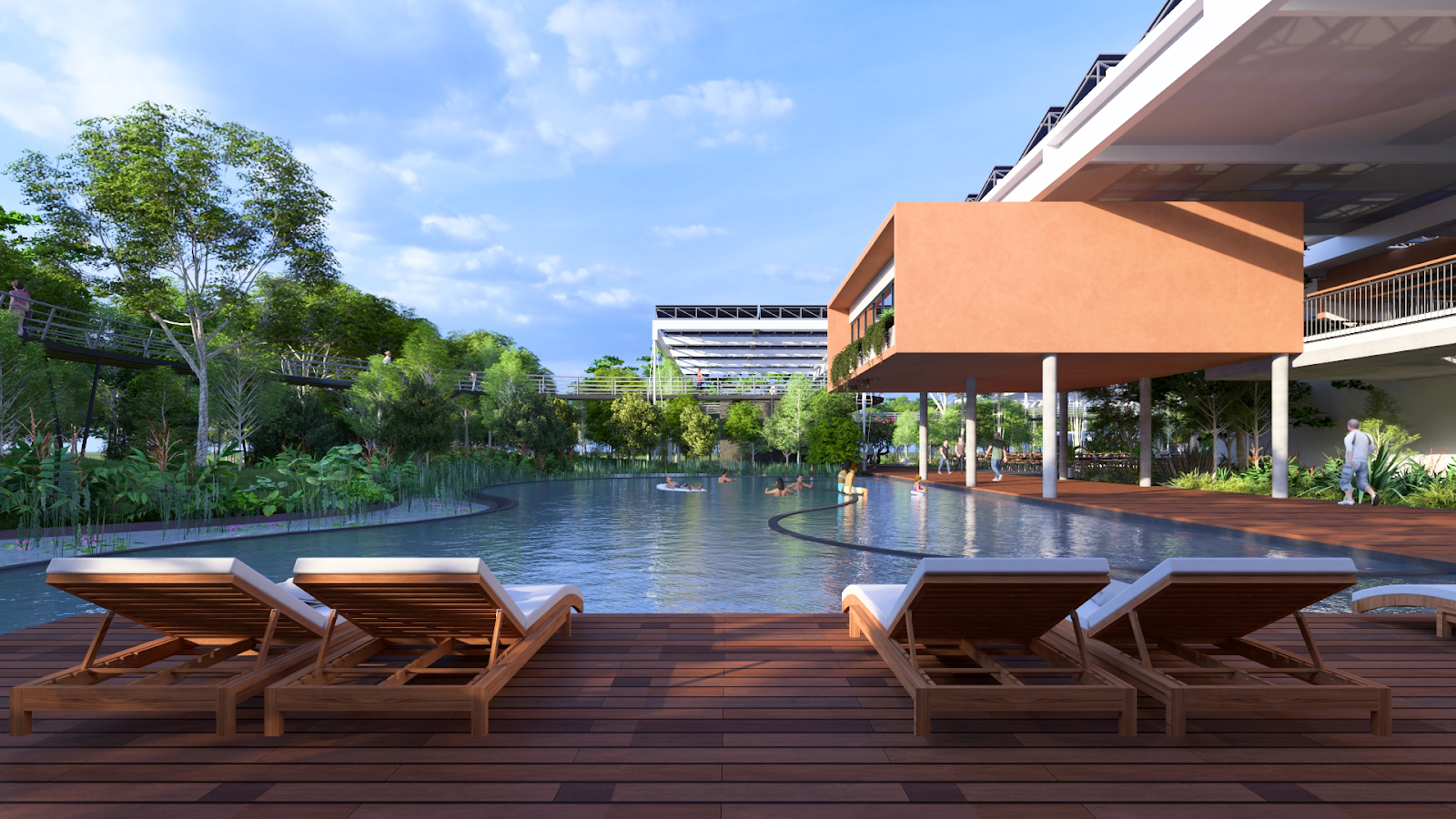
The swimming pond at Ibrahimpalle is not a chlorinated pool carved into concrete but an ecosystem. A living water body, it invites residents to immerse themselves in nature, not chemicals
A triumph of subtle engineering and landscape integration: The pond is built using filtration systems to ensure water clarity and freshness without synthetic treatments. The form is geometric, mirroring ancient temple tanks more than modern resorts.
The surrounding pool deck is made with cooling natural stone, punctuated by shaded lounge chairs, changing rooms, and observation decks for families. It’s a place for early-morning laps, post-lunch floats, or evening storytelling under the stars.
But more than the physical experience, the pond represents a psychological return to trust in nature. Children learn not to fear water but to respect and enjoy it. Adults rediscover the calm that comes from floating under the open sky. Elders dip feet, share tales, or simply rest in its presence.
It is not a luxury. It is a ritual of reconnection, with water, with land, and with ourselves.
17. Health Lounge: Everyday Health, Thoughtfully Supported
The health lounge at Ibrahimpalle is not a hospital, nor a sterile clinic yet it is a place that supports balance, recovery, and daily care.
The design keeps things simple. Natural light, good air movement, and views of green create a calming setting. Inside, there’s space for consultations, rest, or quiet reading. Residents can use it for follow-ups, wellness check-ins, emergency health support or just to sit and take a breath. The space is flexible enough for both private conversations and simple group sessions.
For families, the space becomes familiar, a quiet reliable support for when there’s cause for worry. Run in collaboration with experts when needed, and care everyday. It becomes part of the landscape of daily care, not something set apart from it.
The health lounge doesn’t call attention to itself. But it’s there, and its presence is steady. It tells residents that their health is part of how the community is planned, not an afterthought, but a quiet anchor.
18. Entrance Pavilion : Rurban living made effortless
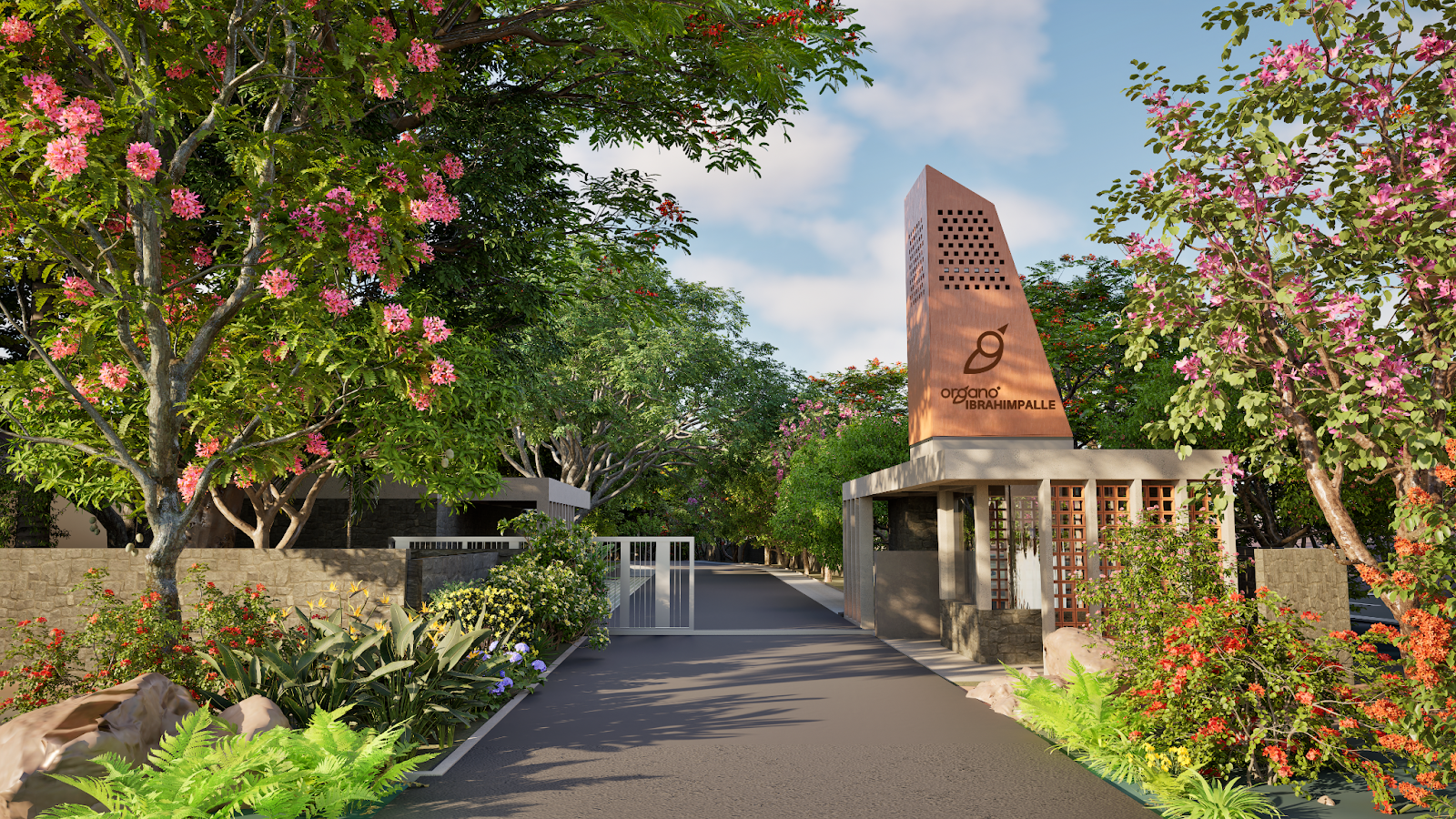
Positioned at the threshold, this compact structure does more than check entries; it anchors the feeling of arrival with care. Set within natural sightlines and layered greenery, its placement ensures visual command without visual dominance. It’s designed to observe, not intrude.
Round-the-clock surveillance, shaded waiting zones for delivery agents, and vehicle check bays are seamlessly integrated into the layout.
The estate manager’s office is the unsung rhythm of the community. It is not designed to impress, but to coordinate, resolve, and quietly enable everyday life.
Architecturally, this space sits close to the entry spine, accessible yet unobtrusive, visible yet not overpowering. Its adjacency to the security zone and service areas ensures that staff, vendors, and maintenance crew flow smoothly through the campus without disrupting the serenity of the lived zones.
From a family’s lens, the estate office is a place of function and problem-solving, but also of patience and empathy. Materials here are deliberately non-hierarchical, all chosen to create a space where the community feels heard. Staff get ergonomic desk stations, back-of-house storage, and a team zone to conduct their work with dignity and effectiveness.
In truth, this is not just an office, it is the engine room of smooth living.
Belonging at Ibrahimpalle is not about mere amenities accessible to groups or ticking off a condo-equivalent checklist. It is placemaking. Each space is crafted to rest in balance with its surroundings, and to enable an effortless engagement with a different version of self; more activity, more community bonding, more opportunities for spontaneous connection, easy moments with family, a healthier body with a set up that invites participation. Ultimately, thriving effortlessly.
Related blogs


%2520(1).jpeg)
.png)